Space and Astronomy
The context for a community on earth crystallizes when it is framed against the context of earth in space. That is, earth is a planet in a solar system. The solar system is one of a number of other sun based systems in a galaxy. The galaxy is one of a number of galaxies in what we call a "universe". To work down from the other direction: the universe contains a number of galaxies. Each galaxy is made of a number of stars. It has now been discovered that many stars also have planets orbiting around them. Our earth is one such planet.
When placing earth in this context, the incentive to build and maintain an integrated community becomes much stronger. Sophisticated technological equipment is not needed to test systems and processes on earth in a benign environment. What is needed is a recognition that the systems and processes being tested could be used in other environments, including other planets and their moons.
Earth
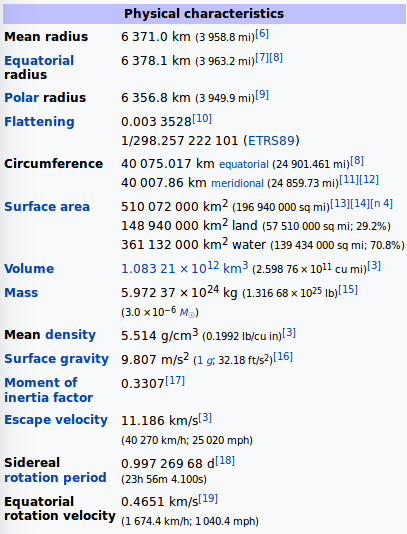
Earth is a planet which has a mean radius of 6,371 km, an equatorial circumference of 40,075 km and a surface area of 510,072,000 km2. Of this, 148,940,000 km2 is land and 361,132,000 km2 is water. It has a volume of 1.083 x 10¹² km3 and a mass of 5.972 x 1024 kg, a mean density of 5.514 g/cm3 and a surface gravity of 9.807 m/s2.[1] These data will be important later on when calculations are made based off of the planet as a whole. These calculations are no more difficult than those made for a community, city or country, providing relatively accurate numbers are used.
1. https://en.wikipedia.org/wiki/Earth. Retrieved February 17, 2018 (Decimals rounded off to three places for improved readability.) See here for a screenshot of these parameters.
Sun
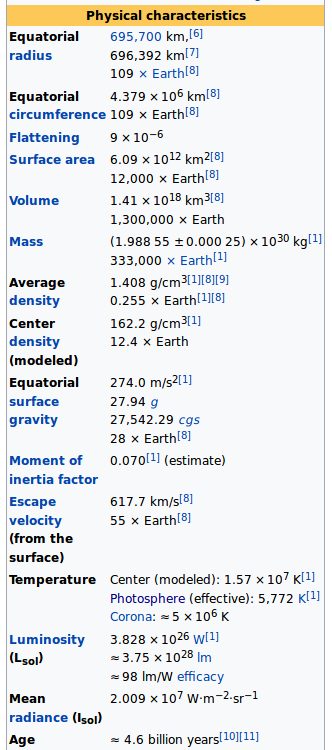
The sun (the bright object that lights the sky during the earth's day) has an equatorial radius of 695,700 km, an equatorial circumference of 4.379 x 10⁶, a surface area of 6.09 x 10¹² km2 and a volume of 1.41 x 10¹⁸ km3. It has an average density of 1.408 g/cm3 and an equatorial surface gravity of 274.0 m/s2. The temperature of the photosphere is 5,772 K and the temperature of the corona is 5 x 10⁶ K. The mean radiance is 2.009 x 10⁷ W·m-2·sr-1.[2] These data are important when considering the effect the sun has on the earth in terms of climate, temperature and energy available for collection via solar panels, for example.
2. https://en.wikipedia.org/wiki/Sun. Retrieved February 18, 2018. See here for a screenshot of these parameters.
Stars
The map below shows all of the star systems within 14 light-years of the Sun (shown as Sol), except for brown dwarfs discovered after 2009. Double and triple stars are shown "stacked", but the true location is the star closest to the central plane. Color corresponds to the table contained in the page referenced below.
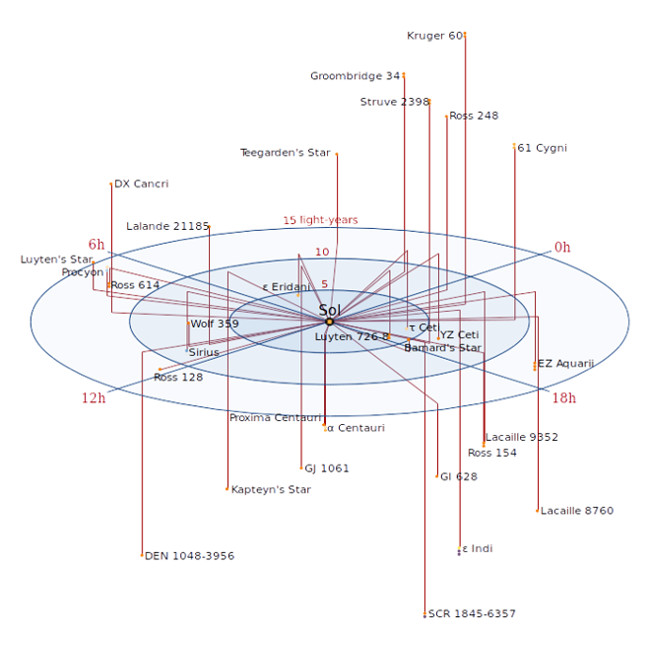
3. https://en.wikipedia.org/wiki/List_of_nearest_stars_and_brown_dwarfs. Retrieved March 17, 2018. (A table on the same page shows details on 55 systems within 5 parsecs--or 16.3 light years--from our own solar system).